
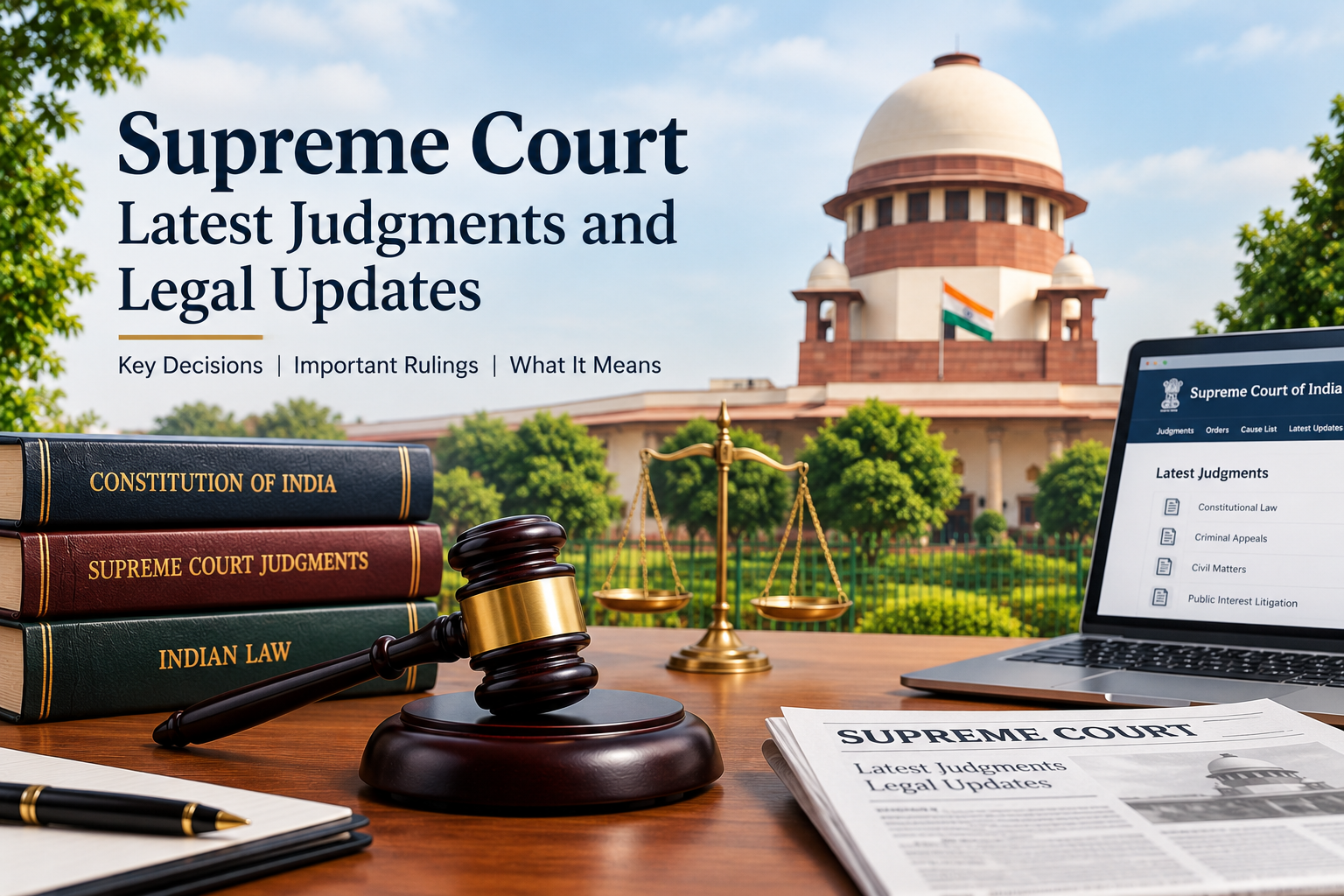
The Supreme Court of India is the highest judicial authority in the country. It plays an important role in protecting the Constitution, maintaining the rule of law, and ensuring justice for citizens. People across India follow Supreme Court judgments and legal updates to understand important changes in the legal system and their impact on daily life.
The Supreme Court hears different types of cases, including constitutional matters, criminal appeals, civil disputes, public interest litigations, and cases involving fundamental rights. Its decisions can influence government policies, lower court proceedings, businesses, public institutions, and individual citizens.
The topic Supreme Court Latest Judgments and Legal Updates is important for students, lawyers, researchers, journalists, and anyone interested in Indian law. By following reliable legal updates, readers can learn about important court decisions, understand legal principles, and stay informed about developments in the Indian judiciary.
What Is the Supreme Court of India?
The Supreme Court of India is located in New Delhi and serves as the country’s highest court. It was established on 28 January 1950, shortly after India became a republic. The Court operates under the Constitution of India and has the authority to interpret constitutional provisions and decide important legal disputes.
The Supreme Court performs several important functions. It hears appeals against decisions of High Courts and other courts in cases permitted by law. It also deals with constitutional questions, disputes involving the Union and states, and matters that require the protection of fundamental rights.
One of its most important responsibilities is ensuring that laws and government actions comply with the Constitution. When a legal question affects the interpretation of the Constitution, the Court’s decision may provide guidance for courts and public authorities throughout India.
The Supreme Court also helps maintain consistency in the legal system. Its legal principles guide lower courts when they decide similar issues. This makes Supreme Court judgments an important part of India’s judicial framework.
Importance of Supreme Court Latest Judgments
Supreme Court judgments are important because they explain how laws should be interpreted and applied. A judgment may clarify an existing legal provision, settle a dispute, explain constitutional rights, or establish principles that influence future cases.
Under Article 141 of the Constitution of India, the law declared by the Supreme Court is binding on all courts within the territory of India. This makes its legal interpretations particularly significant for the country’s judicial system.
Following the latest judgments can help people understand how courts approach important legal questions. For example, decisions involving criminal procedure may affect the way certain cases are handled. Judgments concerning constitutional rights may explain the legal protections available to individuals. Decisions involving employment, property, or commercial disputes may also provide useful guidance.
However, every judgment must be understood in its proper context. A court decision may apply to specific facts, a particular law, or a defined legal question. Readers should avoid assuming that every judgment automatically changes the law for every situation.
Major Types of Cases Heard by the Supreme Court
The Supreme Court deals with several categories of legal matters. Understanding these categories makes it easier to follow court news and legal updates.
1. Constitutional Cases
Constitutional cases involve the interpretation of the Constitution of India. These matters may concern fundamental rights, the powers of government institutions, the division of powers between the Union and states, or the constitutional validity of laws.
Such cases are significant because their outcomes may influence public administration, individual freedoms, and the functioning of democratic institutions.
2. Criminal Cases
Criminal cases involve offences, criminal investigations, trials, convictions, and sentences. The Supreme Court may hear criminal appeals and other matters permitted under the Constitution and applicable laws.
Its decisions can clarify legal principles relating to evidence, fair trials, bail, sentencing, and criminal procedure. However, the result of each case depends on its facts, evidence, and applicable law.
3. Civil and Property Disputes
Civil cases may involve property ownership, contracts, inheritance, compensation, and other disputes between individuals or organisations.
The Supreme Court generally considers such matters through the appellate process or other procedures available under law. Its decisions can explain how particular legal provisions should be applied to disputes involving civil rights and obligations.
4. Public Interest Litigation
Public Interest Litigation, commonly known as PIL, allows eligible persons or organisations to approach the Court regarding certain matters of public importance, subject to applicable legal requirements.
PIL cases may involve environmental protection, public welfare, human rights, and government accountability. Courts assess whether the matter is appropriate for public interest proceedings and whether judicial intervention is justified.
5. Employment and Service Matters
Employment-related cases may concern recruitment, promotions, retirement benefits, service conditions, and disputes involving public employment.
The Supreme Court may hear such matters when the legal requirements for its jurisdiction are satisfied. These decisions can help clarify the interpretation of service rules and other applicable legal provisions.
How to Follow Supreme Court Legal Updates
Readers can follow Supreme Court developments by checking official court information and reviewing reliable legal reporting. It is important to distinguish between a final judgment, an interim order, a hearing update, and a news report about a pending case.
The following steps can help readers stay informed:
- Check official court information: Look for published judgments, orders, cause lists, and official announcements.
- Read the full judgment when necessary: A news headline may not explain all the legal details or limitations of a decision.
- Verify the case name and date: This helps readers identify the correct matter and avoid confusion between similar cases.
- Understand the procedural status: A case may still be pending even if the Court has heard arguments or issued an interim order.
- Compare reliable reports: When a judgment receives significant public attention, reading more than one credible report may provide better context.
- Avoid unverified social media claims: Short posts can leave out important details or misrepresent the outcome of a case.
These practices can help students, legal professionals, and general readers understand Supreme Court legal updates more accurately.
How to Understand a Supreme Court Judgment
Legal judgments often contain complex language, references to previous cases, and detailed discussions of legislation. Readers can make them easier to understand by focusing on a few important sections.
First, identify the name of the case and the parties involved. This provides basic information about the dispute. Next, read the background to understand how the matter reached the Supreme Court.
The next step is to identify the main legal question. This is the issue the Court was required to decide. The judgment may then discuss the arguments presented by the parties, the relevant laws, and earlier judicial decisions.
Pay close attention to the Court’s reasoning. This section explains why the judges reached their conclusion. Finally, read the operative portion or final order to understand the actual result.
It is also useful to distinguish the legal principles necessary for the decision from observations made during the discussion. Not every sentence in a judgment has the same legal significance.
For complicated matters, readers should consult a qualified legal professional rather than relying only on a short summary.
Supreme Court Judgments and Fundamental Rights
Fundamental rights are an important part of the Constitution of India. They protect essential freedoms and provide legal safeguards against certain forms of unlawful action.
The Supreme Court plays a major role in interpreting and protecting these rights. Article 32 of the Constitution provides a constitutional remedy for the enforcement of fundamental rights before the Supreme Court.
Depending on the legal circumstances, the Court may issue writs such as habeas corpus, mandamus, prohibition, certiorari, and quo warranto. These remedies have different purposes and are available subject to legal requirements.
Supreme Court decisions involving fundamental rights can clarify the scope of constitutional protections. They may address questions concerning personal liberty, equality, freedom of expression, privacy, and other constitutional guarantees.
Such judgments are important not only for the individuals involved in a case but also for understanding how constitutional protections operate in practice.
Impact of Supreme Court Decisions on Ordinary Citizens
Supreme Court judgments can affect many areas of everyday life. Their impact depends on the subject of the case and the legal principles involved.
For example, a decision concerning consumer protection may clarify the legal responsibilities of businesses or service providers. An employment-related judgment may explain the rights and obligations of employees in a particular legal context. A criminal law decision may clarify how a procedural safeguard should be applied.
Environmental judgments can influence how legal duties concerning pollution or natural resources are enforced. Constitutional decisions may affect the relationship between citizens and public authorities.
However, the practical effect of a judgment is not always immediate or universal. Some decisions apply to the parties involved, while others establish legal principles with broader significance. The wording of the judgment, relevant legislation, and subsequent court proceedings may all affect its application.
For this reason, people should read legal updates carefully and seek professional advice when a decision relates directly to their own legal circumstances.
Role of the Supreme Court in the Indian Judiciary
India has an integrated judicial system that includes the Supreme Court, High Courts, and subordinate courts. Each level has its own jurisdiction and responsibilities.
The Supreme Court serves as the highest judicial authority and helps maintain consistency in the interpretation of law. High Courts exercise jurisdiction within their respective states or territories, while subordinate courts handle many civil and criminal matters at the local level.
When the Supreme Court interprets a legal provision, its binding legal principles guide other courts in accordance with Article 141. This helps promote consistency and predictability in the application of law.
The Court also plays a constitutional role by examining legal questions involving government powers and individual rights. Its decisions contribute to the development of Indian jurisprudence and help explain how constitutional principles apply to changing circumstances.
Why Accurate Legal News Matters
Legal news can help people understand important court developments, but accuracy is essential. Headlines sometimes simplify complicated judgments or focus on only one part of a decision.
Readers should check whether a report describes a final judgment, an interim order, a direction issued during a hearing, or an argument made by a lawyer. These are different things and should not be treated as equivalent.
It is also important to verify whether a decision has been stayed, reviewed, modified, or considered in later proceedings. A legal position may evolve as new cases are decided or legislation changes.
For educational and research purposes, official judgments and orders are generally more useful than short summaries alone. Reliable reporting can provide helpful context, while the full decision offers a clearer understanding of the Court’s reasoning and directions.
Accurate legal information encourages informed discussion and reduces the risk of spreading misleading claims about the justice system.
Conclusion
The Supreme Court of India plays a central role in interpreting the Constitution, resolving important legal disputes, and protecting fundamental rights. Its judgments influence the development of law and provide guidance to courts throughout the country.
Following Supreme Court Latest Judgments and Legal Updates helps readers understand significant legal developments, constitutional principles, and the possible impact of court decisions on society. Students can use these updates for learning, legal professionals can follow developments in their fields, and citizens can improve their understanding of the judicial system.
For accurate information, readers should review official judgments and orders, verify important details, and distinguish final decisions from interim developments. When a judgment affects a personal legal matter, consulting a qualified lawyer is the best way to understand how the law applies to the specific situation.
Staying informed about Supreme Court decisions supports legal awareness and helps people better understand the role of justice, constitutional values, and the rule of law in India.
Frequently Asked Questions (FAQs)
1. What is the Supreme Court of India?
The Supreme Court of India is the country’s highest court. It interprets the Constitution, hears cases within its jurisdiction, and decides important legal disputes.
2. Why are Supreme Court judgments important?
Supreme Court judgments clarify the interpretation of laws and constitutional provisions. Under Article 141, the law declared by the Court is binding on all courts in India.
3. How can I follow Supreme Court latest judgments?
You can check official court publications and read reliable legal news reports. For important matters, reviewing the full judgment or order provides better context.
4. What types of cases does the Supreme Court hear?
The Court hears constitutional matters, civil and criminal appeals, disputes involving the Union and states, fundamental rights cases, and other matters permitted by law.
5. What is Article 141 of the Indian Constitution?
Article 141 states that the law declared by the Supreme Court is binding on all courts within the territory of India.
6. What is Article 32?
Article 32 provides a constitutional remedy for people seeking enforcement of their fundamental rights before the Supreme Court.
7. Are all Supreme Court orders final judgments?
No. The Court may issue interim orders, procedural directions, and final judgments. Their legal effect depends on the nature and wording of the order.
8. Can Supreme Court judgments affect ordinary citizens?
Yes. Depending on the subject, judgments may influence legal rights, government actions, employment disputes, criminal proceedings, and other areas of public life.
9. Can I understand a Supreme Court judgment without legal training?
You can begin by reading the case background, legal issue, reasoning, and final order. Complex judgments may require help from a qualified legal professional.
10. Why should I follow Supreme Court legal updates?
Following reliable legal updates helps you understand developments in Indian law, learn about important court decisions, and improve your legal awareness.

